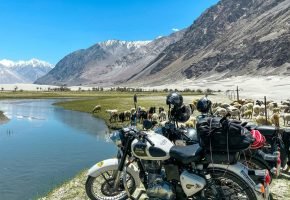
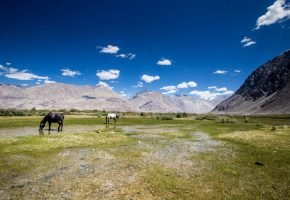
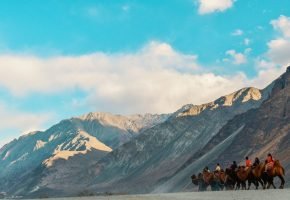
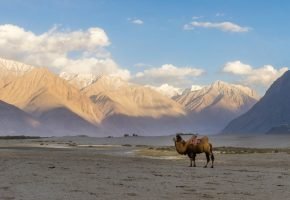
Nubra Valley lies quietly on the northern side of Leh, separated by the high Khardung La Pass. On a map, it looks like a wide-open bowl carved by two best rivers, the Shyok and the Nubra, both running through cold deserts and tiny green villages. Although it belongs to Ladakh, the landscape feels like a completely different world: half desert, half oasis. The valley sits close to the borders of Pakistan and China, which adds a layer of mystery and strategic importance.
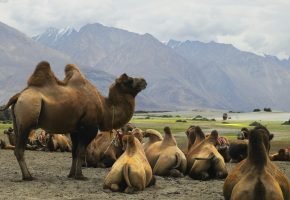
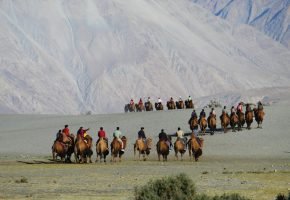
Nubra Valley is a rare cold desert sitting over 10,000 feet high, where soft sand dunes blend unexpectedly with snow-covered mountain peaks. As you walk through the valley, you may feel warm sunlight on the dunes yet encounter icy winds near the rivers. The famous double-humped Bactrian camels, once travelers of ancient Central Asian trade routes, still roam the Hunder dunes like living pieces of Silk Route history.
The valley’s gentle climate also allows apricot trees to bloom in large numbers, filling the air with a sweet fragrance during summer. Because Nubra lies close to important borders, you will notice Indian Army camps that highlight how remote and strategic this region is. Scattered across the valley are peaceful villages like Diskit, Turtuk, and Sumur, where traditional Ladakhi life continues in mud houses surrounded by prayer flags, barley fields, and a pace of living that feels beautifully frozen in time.
Nubra Valley is filled with places that feel both magical and untouched. The journey begins at the Hunder Desert, where soft golden waves of sand shaped by the cold Shyok River winds create a dreamlike desert, made even more special by the gentle double-humped camels that wander through it.
A short drive away stands Diskit Monastery, the oldest in the region, crowned by a towering 106-foot Maitreya Buddha statue that seems to watch over the valley with calm presence; the air here carries the flutter of prayer flags and the faint scent of aged wood. Further north lies Turtuk, one of India’s last villages before the border, warmer and greener than the rest of Ladakh, with stone paths, apricot orchards, and a distinct Balti culture that is found nowhere else.
Towards the quieter side of Nubra, the villages of Sumur and Panamik offer peaceful farmland views and the soothing Panamik Hot Springs, whose naturally warm, sulphur-rich water feels like a gift in the cold desert climate. And to reach all of this, travelers cross the mighty Khardung La Pass, a dramatic, high-altitude gateway that opens the door to the hidden world of Nubra Valley.
Food in Nubra Valley reflects the region’s cold climate and warm culture. The day often begins with a cup of butter tea, a salted and buttery drink that may taste unusual at first but carries the deep tradition of Ladakhi hospitality. Alongside it, locals prepare comforting dishes like Thukpa and Skyu, slow-cooked noodle soups made with barley flour and fresh vegetables, perfect for cold evenings.
Khambir, a thick circular bread baked in village kitchens, pairs beautifully with either butter tea or homemade apricot jam. Travelers also enjoy Chhurpi, a hard, chewy dried cheese made from yak milk that works well as a long-lasting snack on journeys. And everywhere you go, apricots make an appearance, whether in the form of dried fruit, fragrant oil, sweet jam, or simple homemade desserts that capture the valley’s natural sweetness.
Official tourism section of the Ladakh government (covers tourism across Ladakh including Nubra): https://ladakh.gov.in/tourism/ (official UT tourism info)
These are the official government pages where you can get authentic information about Nubra Valley, attractions, access, and guidelines directly from the UT administration.
Sanchi Stupa is located on a hilltop in Chanspa, Leh, in the Union Territory of Ladakh, India. The stupa offers panoramic views of the Leh town and the snow-capped peaks of the Ladakh Read More
Leh Palace stands proudly on Namgyal Hill, offering a commanding view over Leh Town in Ladakh, northern India. Visible from nearly every part of the town, it’s just a short walk or drive Read More
Magnetic Hill is located on the Leh-Kargil-Baltic National Highway, about 30 kilometers from Leh, Ladakh, India. It is situated between the Himalayan hills and the Indus River.Read More
Make Reason to Travel
Books transport us to new worlds with every page, but travel lets us live those stories. Documentaries show breathtaking places, but stepping beyond the screen brings them to life. Movies spark adventure, but the real magic begins when we pack our bags and go. 🌍