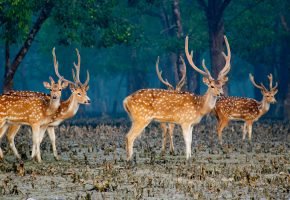
Tucked away in the delta where the Ganges, Brahmaputra, and Meghna rivers embrace the Bay of Bengal, the Sundarbans is more than a forest—it’s a realm of wonder carved by tides, time, and tales. Spanning southern West Bengal in India and stretching into Bangladesh, the Sundarbans is the world’s largest contiguous mangrove forest. But it’s not just the statistics that make it special; it’s the pulse of nature, the silence of the swamps broken by the sudden splash of crocodiles, and the rustle of tiger paws on soft mud.
The Indian part of the Sundarbans is a few hours’ journey from the urban chaos of Kolkata. What’s fascinating is how geography here is in constant negotiation—rivers shift, islands vanish, and new ones emerge. This is a land born from sediment and silt, where over 100 islands form a natural maze, and boats, not buses, are the lifeline of daily life.
The soil is saline, the air thick with humidity, and the terrain changes with the tide. Villages are perched like secrets between mangrove walls, and even daylight feels softer here, filtered through canopies of Sundari trees (from which the region gets its name).
Most people know the Sundarbans for the elusive Royal Bengal Tiger, but the forest holds far more than just its top predator. It’s a biodiversity hotspot, home to saltwater crocodiles, Ganges River dolphins, mudskippers, monitor lizards, and even the rare masked finfoot. Unlike the open savannas of Africa or the dry zones of Rajasthan, spotting wildlife here is a test of patience and presence.
What truly sets the Sundarbans apart is how humans and animals share space. Villagers light up oil lanterns at the edge of their huts to keep tigers away. Honey collectors chant protective mantras before venturing into the forest.
Sajnekhali Watchtower serves as the entry point to the forest, surrounded by a bird sanctuary and the informative Mangrove Interpretation Centre, offering your first real connection with the wild. Sudhanyakhali Watchtower provides a quiet lookout where you might spot tigers or deer near the water channels. The Dobanki Canopy Walk offers a thrilling 500-meter walk above the forest, revealing a rare top-down view of the mangroves.
To truly understand the Sundarbans, one must go beyond camera clicks. Here, resilience lives in the breath of every villager who rows through crocodile-infested waters. Faith is stitched into the clothes of Bonbibi, the forest goddess worshipped by Hindus and Muslims alike, invoked before entering the woods.
There are no neon lights or luxury resorts in the core zones. Yet, at night, under a canopy of stars, with the distant call of an owl and the occasional howl of a tiger, you understand why some places don’t need decoration.
Let's Connect With
West Bengal Tourism Development Corporation :: WBTDCL ::
Happy Valley Tea Estate is one of the oldest tea gardens in Darjeeling, tucked quietly on the hillside just a short drive away from the main town. The moment you step into the estate, Read More
Tucked amidst the heart of Kolkata’s colonial past, the Victoria Memorial stands as a monument, as a living chapter of India’s complex encounter with the British Empire. Read More
Tiger Hill Located about 11 kilometers from Darjeeling town; this hilltop offers a dramatic panoramic view of some of the world’s tallest peaks. As the first golden light touches the Read More
Make Reason to Travel
Books transport us to new worlds with every page, but travel lets us live those stories. Documentaries show breathtaking places, but stepping beyond the screen brings them to life. Movies spark adventure, but the real magic begins when we pack our bags and go. 🌍